
Compare your options
Mild Steel vs Stainless Steel Floor Scales for Warehouses and Food Processing
Compare mild steel and stainless steel floor scales for dry warehouses, wet areas and food processing. Review cleaning, components and lifetime costs.
Introduction
Choose between mild steel and stainless steel floor scales by assessing moisture, cleaning chemicals, product exposure, maintenance access, and the complete component specification. Painted mild steel can suit a dry warehouse. Wet or frequently cleaned applications require a closer review of stainless construction, enclosure protection, and hygienic design.
The material decision is rarely just about whether a platform will rust. It affects how the equipment is cleaned, how damage is identified, and how easily technicians can inspect the components beneath the deck. Those consequences matter throughout the product's working life.
This guide helps procurement teams, distributors, and plant engineers compare material choices without assuming that every stainless steel scale is washdown-ready or that every painted scale is unsuitable. Application examples are hypothetical; the final selection depends on the proposed model and your actual operating conditions.
What is the practical difference between the materials
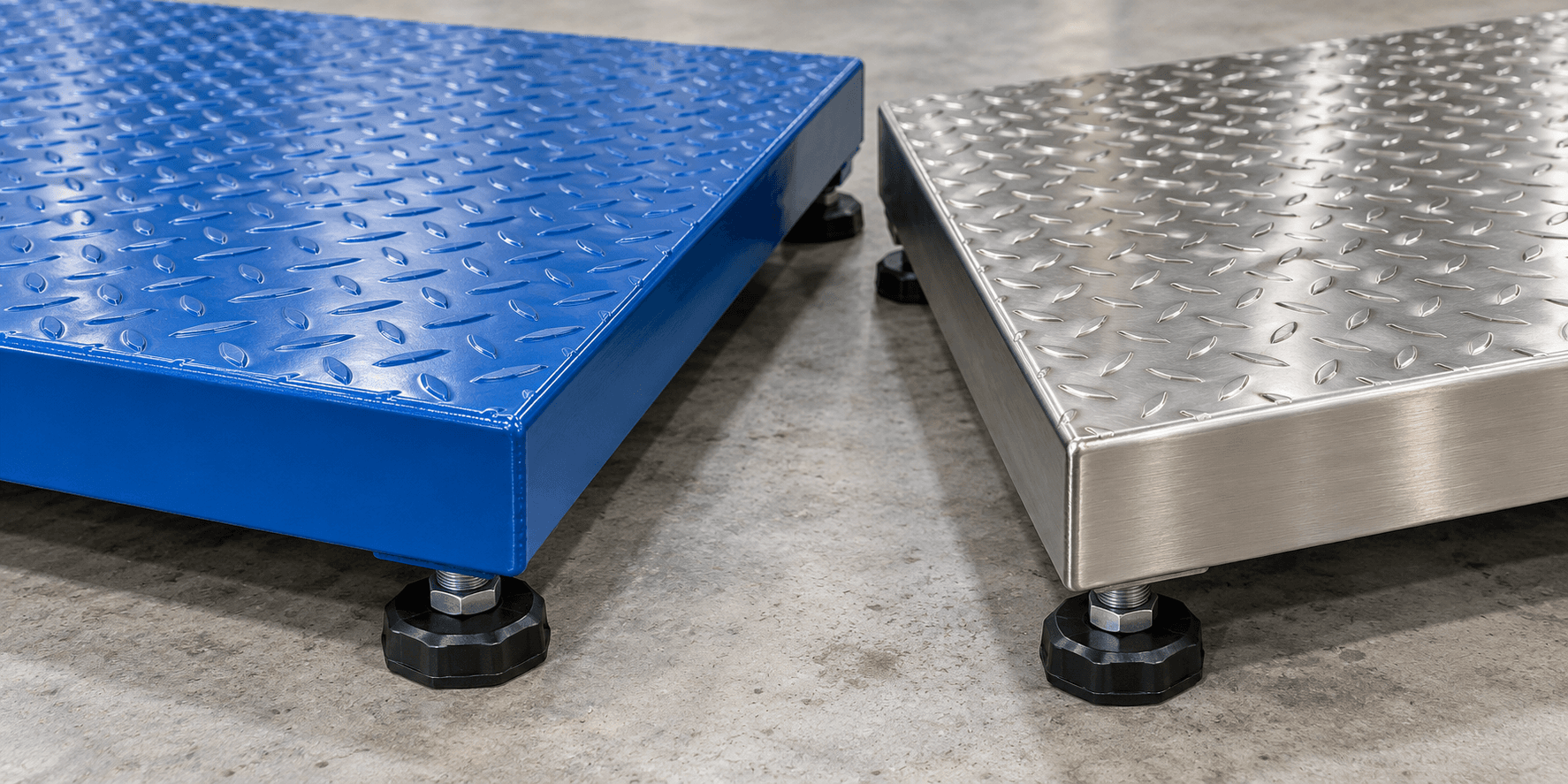
Mild steel platforms generally depend on a protective finish to separate the underlying steel from the environment. The finish may perform well in suitable conditions, but abrasion, impacts, and standing moisture can affect protection. The quotation should identify the actual finish rather than simply describe the platform as painted.
Stainless steel uses an alloy whose corrosion behavior differs from ordinary carbon steel. It can be appropriate for wet environments, but performance still depends on grade, fabrication, surface condition, chemicals, and cleaning practice. The word stainless does not mean immune to corrosion.
Neither material determines weighing accuracy by itself. The load cells, mechanical design, installation, electronics, and operating environment also influence measurement performance. A material upgrade should address an identified exposure or cleaning requirement rather than serve as a substitute for a complete technical specification.
Compare material choices by application
| Application condition | Painted mild steel | Stainless steel | Procurement question |
|---|---|---|---|
| Dry indoor pallet handling | Often a practical starting point | May be justified by other requirements | Will cleaning or condensation change the exposure? |
| Occasional wet cleaning nearby | Requires review of splash and drying conditions | Requires review of grade and protected components | Which parts are actually wetted? |
| Frequent washdown | Assess only against a clearly defined suitable construction | Consider a configuration designed for the cleaning procedure | Are chemicals, temperature, pressure, and access addressed? |
| Food production zone | Material choice depends on the process and contamination risks | Often considered alongside hygienic design | Can the entire assembly be cleaned and inspected? |
| Outdoor or coastal installation | Coating and exposure need specific assessment | Grade and fabrication still need assessment | What moisture, salts, drainage, and weather conditions apply? |
Use this table to frame the enquiry, not to approve a product. Two scales with the same deck material can have different frames, fasteners, enclosures, and maintenance requirements. Compare the actual construction shown on the drawing and component list.
Map the environment before requesting a quotation
Distinguish humidity from direct washing
A humid room, a splash area, and a zone cleaned with a directed water jet create different demands. Describe where water comes from, how long components remain wet, and whether the equipment dries between cleaning cycles.
Cold-room transitions also deserve attention. Equipment moved between warmer and colder areas may experience condensation. Explain the operating sequence and whether relocation occurs during a shift, after cleaning, or only during maintenance.
Identify dust, powders, salts, and product residues as well. A platform can look dry while material collects under the deck, around feet, or inside damaged covers. Site photos should show the surroundings and underside access, rather than only the top surface.
Separate the production zones
A warehouse storing sealed cartons may need a different specification from a wet processing room in the same facility. Selecting every scale around the most severe environment can add unnecessary cost; selecting every scale around the driest area can leave unsuitable equipment in production.
Create an equipment schedule by zone. Record the load, cleaning method, product exposure, and required functions for each location. This helps a supplier propose consistent equipment where appropriate while identifying the locations that need a different construction.
Review stainless grade and fabrication together
What should buyers ask about 304 and 316
Grade designations are useful starting points, but they cannot establish compatibility with an unspecified chemical process. Ask the supplier to review the grade against the cleaning agent, concentration, temperature, contact time, and exposure frequency.
If a specification offers different grades, identify which parts use each one. The deck, frame, feet, fasteners, and enclosure may not all have the same material. A stainless top plate on a differently constructed frame is a different package from an all-stainless structural assembly.
Ask how welds and surfaces are finished and whether material documentation is available where required. Avoid selecting a grade from an isolated claim such as “better corrosion resistance” without connecting it to the actual environment.
Why surface condition matters
Examine corners, seams, drainage paths, and areas that can retain residue. A polished visible surface does not demonstrate that the underside or joints are easy to clean. Poor access can make an otherwise suitable material difficult to maintain.
For hygienic applications, define the required surface finish and documentation with the responsible quality or engineering team. Do not invent a universal surface roughness requirement for every floor scale; the applicable requirement depends on the use, location, and specification.
Hygienic design involves the whole assembly
A floor scale in a food facility must be evaluated around how contamination could reach the product or move between areas. Determine whether products are sealed, exposed, or in containers, and whether the deck itself has any intended product contact.
Ask how operators can reach beneath the platform, inspect residue traps, and clean around the feet. Features such as drainage, accessible surfaces, and protected joints should be evaluated against the facility's cleaning procedure. A lift-up platform is useful only when its lifting, support, and cleaning arrangements are suitable and documented.
METTLER TOLEDO's hygienic design guidance treats materials, surface condition, cleanability, and equipment features as related selection considerations. This supports evaluating the assembled scale instead of treating stainless steel as a complete hygiene specification. Reference: Hygienic design considerations.
Ask for drawings or clear underside photographs of the proposed construction. If a supplier cites a hygiene certification, verify the certificate's scope and the exact covered model. A statement about a product family should not silently become a claim about every available variant.
Check load cells, junction boxes, and cable entries
The platform is only one part of the weighing system. A wet environment can expose load cells, junction boxes, connectors, and indicator enclosures even when the deck itself remains in good condition. Compare protection component by component.
Request the proposed load cell model, enclosure details, cable arrangement, and location of the junction box. Determine whether connectors are exposed during normal washing and how damaged cables can be identified and replaced.
A published IP rating applies to the specified enclosure or component under stated test conditions. It does not, by itself, establish resistance to your cleaning chemicals or prove that a complete system can withstand your washing procedure. Ask for the scope and supporting documentation rather than relying on a single rating in a brochure.
Do not assume that an immersion-related rating establishes suitability for hot, high-pressure cleaning. Define your actual process and have the supplier confirm the appropriate protection and limitations. Include installed cable entries and connectors in that review.
Write a cleaning specification that suppliers can evaluate
“Washdown required” is too vague to compare quotations. A useful cleaning specification describes both the process and the equipment's exposure. It also identifies which details remain uncertain so the supplier can request clarification.
Include the following information in the technical brief:
- The cleaning agent and its intended concentration.
- Water temperature and available pressure information.
- Whether cleaning uses a cloth, hose, spray, foam, or another method.
- Frequency, approximate contact time, and rinse procedure.
- Whether the underside is washed and how access is provided.
- Expected drying conditions and any standing water.
Have the facility's responsible team validate these details rather than guessing them from a pump label or chemical container. The resulting specification gives engineering, purchasing, and the supplier a common basis for discussing suitability.
Confirm the permitted cleaning method in the operating instructions. Operators need practical limits they can follow after installation, including restrictions around electrical connections, inaccessible spaces, and maintenance access.
Compare total cost through a defined service period
The purchase price is only one part of the decision. Add installation, cleaning labor, planned inspection, service visits, replacement parts, and the effect of equipment being unavailable. Compare those items over the same buyer-selected period.
Do not assume a universal saving or payback percentage for stainless steel. A dry warehouse with controlled cleaning may obtain little value from a more expensive construction, while a wet production zone may place substantial value on accessible cleaning and suitable protected components.
If a supplier proposes a lower-cost painted platform, ask what coating inspection and repair would involve. If the proposal is stainless, ask about routine care, chemical restrictions, and replacement components. Both options need an operating plan.
Include the cost of local support. A readily serviceable configuration may be more useful than an unfamiliar assembly whose parts or documentation are difficult to obtain. Verify availability for the proposed model rather than assuming that components are interchangeable.
Apply the comparison to two hypothetical locations
Dry dispatch warehouse
Consider a warehouse weighing sealed cartons on pallets. Cleaning uses dry methods, the scale remains indoors, and water is kept away from the weighing area. Painted mild steel may be a reasonable option to evaluate.
The buyer should still check abrasion from pallet handling, paint condition around edges, the loading method, and whether seasonal condensation occurs. A ramp and protected cable route may influence daily usability more than a change in deck material.
If the facility later introduces wet floor cleaning, review the scale's exposure before changing the procedure. The original material decision was based on defined conditions; a new cleaning process may require a new equipment assessment.
Wet food processing room
Consider a room weighing closed ingredient bins where floors and equipment are cleaned regularly. The buyer should evaluate stainless construction together with chemical compatibility, protected components, drainage, and access beneath the deck.
A stainless platform with an exposed unsuitable connector would leave an unresolved weakness. Equally, a protected electrical assembly with inaccessible residue traps would not address the cleaning requirement. The complete arrangement must suit both measurement and sanitation tasks.
Before ordering multiple units, request a review involving purchasing, production, maintenance, and the site's hygiene team. A drawing review or a suitable demonstration can reveal access problems before the specification is repeated across the facility.
Define factory inspection and installation checks
Agree what factory inspection will establish. Relevant checks can include identification of specified materials, construction details, cable protection, included accessories, and the agreed functional or weighing tests. Record the scope in the order rather than assuming that “quality checked” describes a consistent process.
Photographs should identify the actual unit or batch where traceability is required. Request views of the underside, feet, cable entries, junction box, and indicator. A close-up of the top plate alone provides limited information about environmental suitability.
If environmental testing is part of acceptance, agree the test method, component scope, evidence, and responsibility in advance. Do not improvise a high-pressure hose test on equipment that has not been specified for it.
After installation, check that drainage and cleaning access match the reviewed layout. Confirm there are no restraints or debris touching the platform. Establish a baseline measurement check and explain the cleaning limits to operators before production starts.
Balance deck texture with cleaning and handling
A textured deck can help address some handling conditions, while a smoother surface may be easier to clean in others. Compare the proposed surface with the pallet feet, trolley wheels, footwear, residues, and cleaning tools used at the site. Material alone does not resolve those tradeoffs.
Request a detail image or sample description that shows the actual finish. Check how the surface continues into corners and edges, where residues or damage may be harder to see. If slip resistance is a defined site requirement, ask how the proposed surface will be assessed under the relevant conditions rather than accepting a general description such as anti-slip.
FAQ
Is a stainless steel floor scale automatically waterproof
No. Stainless steel describes a material, while water protection depends on the complete construction and the specified protection of electrical components. Confirm the cleaning method, component ratings, connectors, and installation arrangement for the exact configuration.
Is mild steel suitable for a food business
The answer depends on the location and process. A dry warehouse holding sealed products differs from a wet processing room. Review exposure, cleaning, contamination risks, and site requirements before selecting the material and complete scale construction.
Should I always choose 316 instead of 304
Select the grade around the actual environment, chemical exposure, fabrication, and required documentation. A grade designation alone does not confirm suitability. Ask for a review based on the cleaning agent, concentration, temperature, and contact time.
Does stainless steel improve weighing accuracy
Changing the material alone does not establish better accuracy. Measurement performance depends on the mechanical design, load cells, indicator, installation, environment, and test results. Choose materials for their application suitability and assess weighing performance separately.
What information is needed for a washdown scale enquiry
Provide the load range, platform dimensions, installation area, cleaning agents, concentration, water temperature, pressure, frequency, and underside cleaning needs. Add required functions and destination details. Ask the supplier to confirm the entire proposed assembly against that brief.
Can I pressure-wash a scale because its load cells have an IP rating
Do not infer that permission from the load cell rating alone. Confirm the rating scope, complete assembly, connectors, and the manufacturer's permitted cleaning procedure. The washing process must be suitable for all exposed components.
Conclusion
The material decision should follow the environment. Painted mild steel can be appropriate in a defined dry application; stainless construction can address different exposure and cleaning needs when the complete specification supports them.
Compare the platform, frame, electrical components, access, and cleaning instructions as one system. A clear environmental brief provides a stronger purchasing basis than the appearance of the deck or a general washdown label.